



Injuries to the hand are common both in domestic and industrial settings. While the former is usually isolated and low intensity, the later is completely the opposite. In fact in the age of DIY, we have come across a third category of hand injuries which point towards inappropriate usage of power tools which lead to isolated high energy trauma.
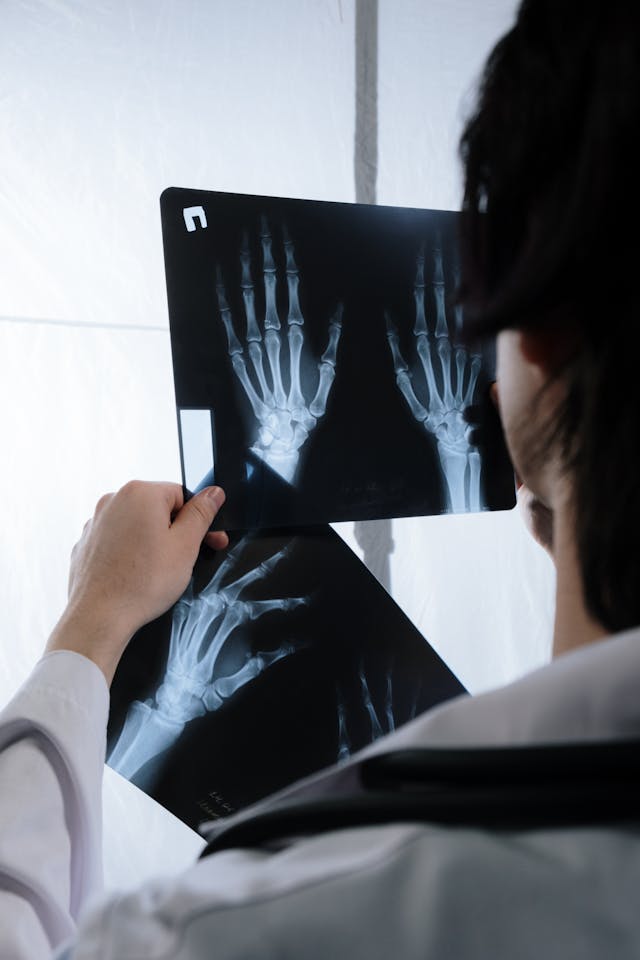
Why are they special ?
Our hands are our skill reservoir. Our ability to perform various tasks, be it activities of self-care to professional activities depends on hand dexterity which is a complex function of movement, stability and sensations. This is in sharp contrast to the lower limb where the balance is skewed towards stability and followed by gross mobility. In fact, how intricately we move the dozen plus joints of our hands are no match to what we do with our feet despite having almost similar arrangement of joints. Since our benchmark for a good able working hand is very different, hand fractures need to be treated with a very different mindset.
What are the key components of a hand fracture ?
Fractures are simply break in the bones. This happens in most cases due to injury, but the injury is never in isolation to the bones only. There is injury to soft tissues, ligaments, and in open fractures – break in the overlying skin as well. All these factors drastically effect the best way to treat the underlying fracture whilst restoring the hand function.
Do hand fractures need surgery?
Hand fractures rarely need surgery for the purpose of bone union. Surgery in hand fractures is more to do with how your hand function can be retained whilst the bone is uniting, which is to enable movements of your hand through the duration of bone healing (4-6 weeks). This is so that you don’t end up with a healed fracture but a stiff hand.
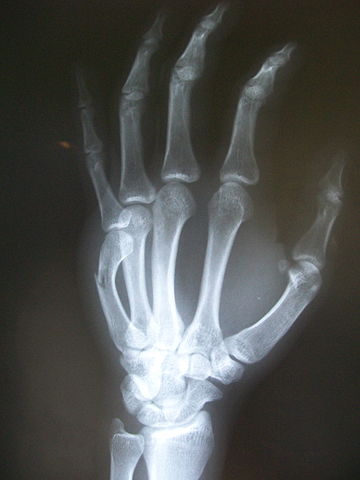
Surgical vs non surgical treatment?
To decide between surgical vs non surgical treatment is the brain game in hand fracture management. There are a series of factors a hand surgeon needs to consider to come to a conclusion. Conceptually , if your surgeon feels that that your fracture is inherently stable and in good position and would continue to be so through the duration which is required for body biology for bone to unite and at the same time allow you to move the joints to the extent that they do not become stiff in the process, these fractures would qualify as ideal or best managed without surgery.
But this scenario is hardly real and never black and white, here your surgeon judges from the mechanism of trauma and injuries to other structures around the bone the likelihood of the fracture being stable. The fracture pattern, complexities of surgical fixation, your hand dominance, profession, existing range of motion and pre existing conditions like arthritis all come in play when such a vital decision is being made. It is after going through this whirlpool of thoughts your surgeon comments on whats best for your case.
What does a hand fracture surgery involve?
The objective of hand fracture surgery is to achieve fixation of the broken bone segments with as minimum manipulation or dissection as possible. This is most instances can be achieved with K wires which are simply stainless steel nails drilled through the skin across the fracture site. This modality is widely practiced , remains least invasive and can be modified as per most fracture configurations
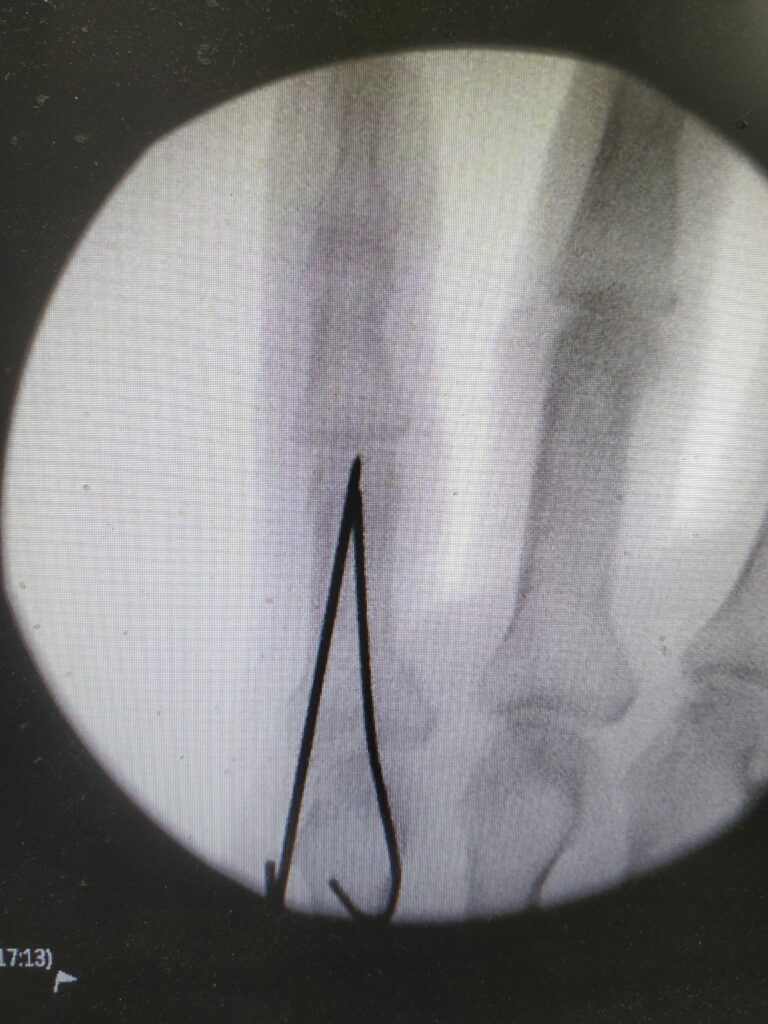
Of course, your surgeon may suggest screw fixation or plating if your fracture is more complex or not amenable to K wiring and very rarely external frames like distractors for more complex situations.
What happens when there is bone loss?
Hand fractures never are isolated bone injuries. Even when there is no skin break , the energy which breaks the bone also impacts soft tissues around it. This impact determines the rehabilitation needed to restore hand function.
This is a very rare scenario in hand injuries. While partial bone loss is rarely a major problem, a complete loss renders either your finger (ray) shortened or incase of fracture involving joint surfaces, permanent joint stiffness. These problems are tough to overcome , but the options include using a bone from one’s own body to bridge the gap, this is known as a bone graft or using an artificial bone substitute to subserve the same function. To restore joint surfaces, artificial joint constructs made of either silicone or metal may be used.
Hand therapy- why is it essential?

Hand therapy is aimed at ensuring that tissues around bone , particularly joints remain dynamic and do not shorten to disable or limit joint mobility. This is achieved by a series of exercises both active and assisted done by a specialist hand therapist. These not only achieve good mechanics needed for hand function but also alleviate chronic hand pain.
Outcome measure in hand fractures
Hand function is a complex product of strength (stability) and mobility. Both these components are inversely related to one other and therefore a perfect balance of the two is what determines hand ability. But despite optimization of these parameters on an individual basis , functional outcome of hand remains extremely uncertain to predict purely on the basis of injury and treatment. This is why hand fracture management practices remain subjective and individualized.
Prominent ears
Ears are the most non geometric external feature of our face. But, nature also has methods to madness, and this is what…
Plastic surgery in management of surgical infections
What are surgical site infections? As the name suggests, it is an infection occurring at…

Breast Reduction
Breast mound not only imparts key cosmesis to the chest wall contour, but it also defines womanhood….
Open fractures of the lower limb – what makes it complex?
Introduction While fractures refer to break in the bones, one tends to ignore that a…
Facial injuries – What makes plastic surgery special?
No wonder that whenever there is an injury to the face, one tends to fear…
Hand Fractures
Injuries to the hand are common both in domestic and industrial settings. While the former…